
James River Fishing in Richmond: Smallmouth and Blue Catfish
Last verified:
By BCRods
Quick facts
- Bass rule
- Non-tidal James: no bass 14 to 22 inches; one over 22
- Tidal river
- Trophy blue catfish, largemouth, spring shad and stripers
- License
- DWR above the freshwater-saltwater line, VMRC below; check the line
- Rod fit
- Medium spinning for smallmouth; heavy rod for blue catfish
Rules snapshot
James River bass rule (Fall Line reach)
From the Jackson and Cowpasture confluence in Botetourt County downstream to the 14th Street Bridge in Richmond: no largemouth or smallmouth bass 14 to 22 inches, and only one a day longer than 22 inches. · 2026 Virginia Freshwater Fishing & Boating digest, checked November 1, 2026
Channel, white and flathead catfish limits
20 a day with no length limit. All rivers below the fall line have no daily limit. DWR says flathead catfish are illegally introduced in some rivers and asks anglers not to move them. · 2026 Virginia Freshwater Fishing & Boating digest, checked November 1, 2026
Blue catfish limit, tidal James River
The 2026 digest prints two different tidal James blue catfish rules. Check the current limit with Virginia DWR. 2026 Virginia Freshwater Fishing & Boating digest
American shad and river herring
American shad: catch and release only statewide. River herring (alewife and blueback): possession is banned, so release them. · 2026 Virginia Freshwater Fishing & Boating digest, checked November 1, 2026
Fisherman Identification Program (FIP)
Saltwater anglers 16 and older who do not hold a Virginia saltwater license must register for a free number each year. Anglers who fish for anadromous or marine species in fresh water must register too. Registration is online through VMRC or by phone at (757) 247-2200. · Virginia DWR freshwater regulations, checked November 1, 2026
Virginia fish consumption advisories
Fish consumption advisories apply on many Virginia waters. Check the Virginia Department of Health advisory list before you keep fish. Virginia Department of Health
This is not legal advice. Rules change, so confirm with the state agency before you fish.
Rules: DWR upstream, VMRC downstream
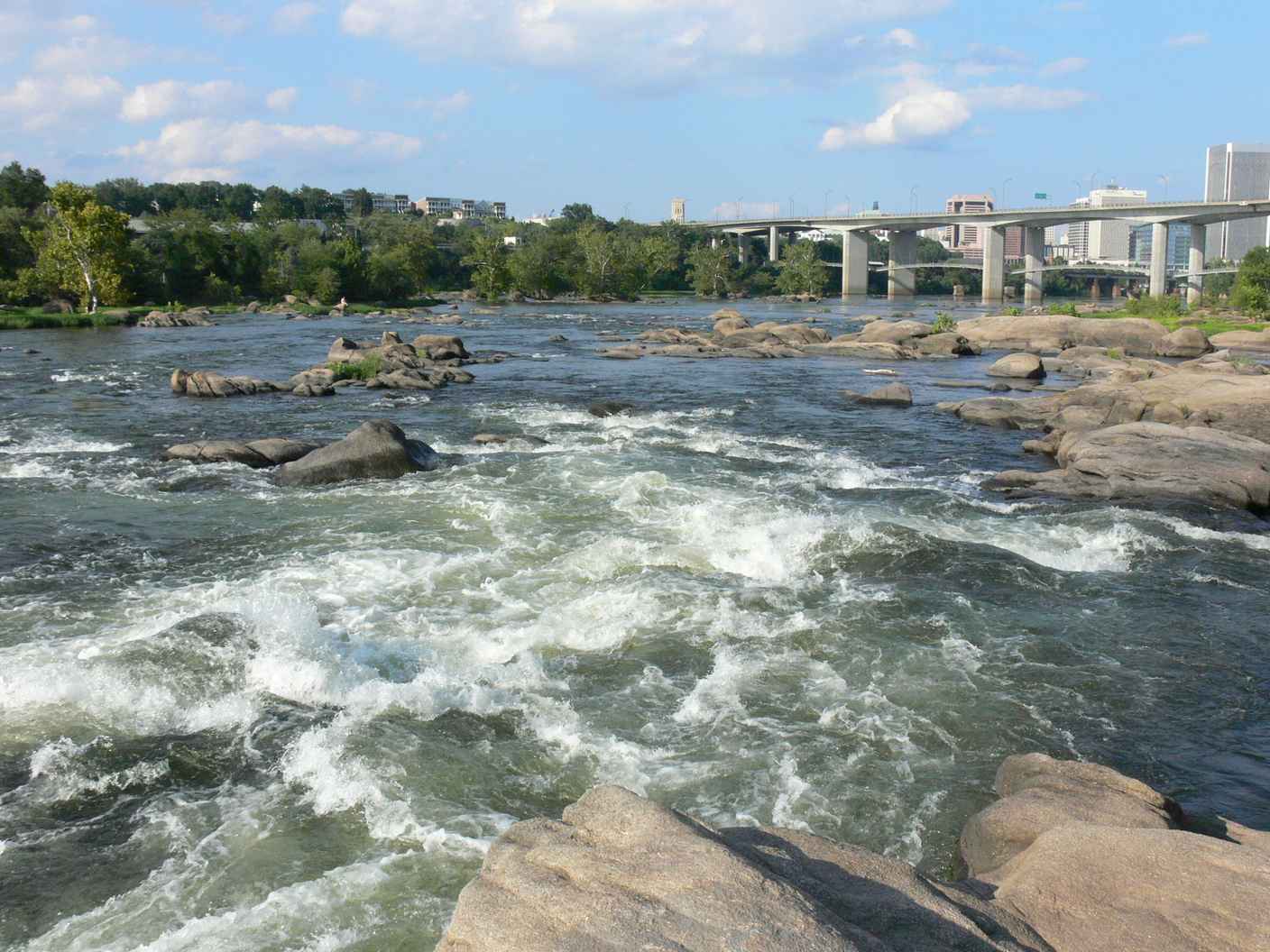
The James River is two fisheries wearing one name. Above Richmond it is a rocky, free-flowing smallmouth river that Virginia’s Department of Wildlife Resources (DWR) manages as the non-tidal James. Below the fall line it turns into a wide tidal river known for trophy blue catfish, largemouth bass, spring shad and striped bass. A third set of rules, a freshwater-saltwater license line, decides which agency and which license apply. This guide walks through both halves from the standpoint of the angler who is staying near Richmond, and it flags what could not be confirmed.
Two agencies on one river
Freshwater fish are DWR’s responsibility. In the tidal James, DWR says that striped bass, shad and herring seasons and limits are set by the Virginia Marine Resources Commission (VMRC), which you can reach in Newport News at 1-800-541-4646. A freshwater license applies upstream of a freshwater-saltwater line on the tidal river and a saltwater license, or the free FIP number for exempt anglers, applies downstream. We have not read DWR’s page that locates the line, so we are not stating where it falls: check DWR’s map before you fish the tidal river. American shad may not be kept in Virginia, and river herring may not be kept at all. The Virginia license and rules guide explains the two licenses.
The non-tidal James
DWR describes the non-tidal James as running from the junction of the Jackson and Cowpasture rivers in Botetourt County to the 14th Street Bridge in Richmond. Smallmouth bass are the most common game fish, with spotted and largemouth bass present, and the river holds channel and flathead catfish and several sunfish. Flatheads are more abundant upstream of Lynchburg and channel catfish below it. DWR stocks muskie each year, and the fish are scarce but can be large, mostly upstream of Lynchburg.
One bass rule covers the whole reach: five black bass a day in total, no bass 14 to 22 inches may be kept, and only one a day may be longer than 22 inches. Catfish are limited to 20 a day. The rules snapshot above quotes DWR’s printed 2026 digest.
For anglers near Richmond, the lower end of the non-tidal river offers a handful of floats listed by DWR. West View to Powhatan State Park is 7.5 miles, with a concrete ramp at West View and boat slides at the park, and the middle of the float is flat water with good smallmouth and bream fishing. Powhatan State Park to Maidens is six miles of mostly flat water with deep pockets for catfish and bass, and only hand-carried boats can launch at the state park. Maidens to Watkins is 13.1 miles, with Class I riffles and islands in the middle and the last 3.5 miles in the pool behind Bosher’s Dam. DWR also gives phone numbers for fishing questions: 804-305-8940 for the fall line at Richmond, and 434-392-9645 for the middle James from Lynchburg to Bosher’s Dam.
The tidal James
DWR describes the tidal James as a nationally recognized largemouth fishery that has hosted major bass tournaments. Its tidal tributaries, from the Appomattox River down to Upper Chippokes Creek, hold much of the best largemouth habitat, with shoreline structure such as old pilings and downed trees beside channel drop-offs. In the main river, largemouth fishing is best above Hopewell. DWR’s older tidal page names the Dutch Gap barge pit, Herring Creek, Powell Creek and Gray’s Creek among the best sites.
The tidal river is also the state’s best fishery for blue catfish. DWR says fish of 30 to 50 pounds are regular and that hundreds of 30 to 60 pound blue catfish come out of the tidal James each year, with the former state record of 102.25 pounds caught there in 2009. It recommends searching for submerged structure such as sunken barges, old piers and downed trees beside channel drop-offs, using fresh-caught gizzard shad or eels, and notes that large fish are mostly caught at night in summer. Most citation-size fish come from the stretch between Dutch Gap and Sturgeon Point. The 2026 digest prints two different blue catfish rules for the tidal James, and DWR’s older page lists a third wording, so we are not stating a limit. Check DWR for the current rule.
Other species round out the tidal river. White perch are plentiful, and crappie of 12 to 13 inches are caught in tidal tributaries and near Jones Neck and Turkey Island. Flathead catfish are caught at the head of tide in spring and are most abundant between Richmond and I-295, and carp are common from Hog Island up to Richmond. For striped bass, DWR says spring fishing near the I-95 bridge can be good on topwater lures, fall fishing is generally best below I-295, and late in the fall the fish move downstream. The spring shad run at the fall line typically peaks from mid April to early May, but American shad must be released.
Public landings
DWR lists these public boat accesses on the freshwater part of the tidal river: Ancarrows Landing in Richmond, Osborne Landing in Henrico County, Dutch Gap in Chesterfield County, Deep Bottom in Henrico County, Chickahominy Riverfront Park in James City County and Lawnes Creek Landing in Surry County. Private ramps with fees include the marinas at Hopewell and Jordan Point.
Fish advisories
A Virginia Department of Health advisory covers fish in the James because of PCBs and the chemical Kepone, which a Hopewell plant released in the 1970s. We could not get a clean read of the current table, so we do not publish meal limits. Check the Virginia Department of Health advisory before you keep a catfish or other fish. The history is in the Kepone tale.
Tackle that suits the river
For smallmouth in the rocky fall-line reach, a 7 foot medium or medium-heavy spinning rod with 8 to 12 pound line handles jigs, tubes and spinnerbaits. For big blue catfish, anglers use heavy rods, large reels, strong line and cut bait or fresh shad, because the fish are strong and the river has current. Those are typical setups, not requirements. A custom rod built for cut bait or for a particular lure weight will fit the river better than a one-size rod.
Check before you go
Landings, closures and the rules above change, and DWR is the place to confirm them. The Shenandoah is covered in its own guide, and Virginia’s lakes are compared in the best-lakes roundup.
Fish you can target here
Smallmouth Bass Fishing in Virginia: Rivers and Slots
Virginia smallmouth on the James, Shenandoah, New River and Jackson: where to fish, the slot rules by river and tactics that work.
Striped Bass Fishing in Virginia: Bay, Coast and Lakes
Virginia striped bass: Bay and coastal seasons and slots, and the lake rules at Smith Mountain and Kerr, with where to fish each.
Dock Tales from this water
Nearby waters
Virginia Fishing License, Limits and Rules
More fishing guides for Virginia
Frequently asked questions
What fish can I keep on the James in Richmond? +
Bass are limited to five a day with no keeping 14 to 22 inches. American shad must be released, and river herring may not be kept. Check the tidal blue catfish rule with DWR.
Where are the public landings on the tidal James? +
DWR lists Ancarrows, Osborne, Dutch Gap, Deep Bottom, Chickahominy Riverfront Park and Lawnes Creek, plus private marinas at Hopewell and Jordan Point.
Is there an advisory on James River fish? +
Yes. A Virginia Department of Health advisory covers fish in the river because of Kepone and PCBs. Check it before you keep fish.
Sources
- Virginia DWR: James River, upper and middle (accessed November 1, 2026)
- Virginia DWR: James River, tidal (accessed November 1, 2026)
- 2026 Virginia Freshwater Fishing & Boating digest (PDF) (accessed November 1, 2026)
- Encyclopedia Virginia: Kepone (accessed November 1, 2026)
Approximate location: James River, Richmond, VA.