
Jackson River and Lake Moomaw: Wild Trout Tailwater
Last verified:
By BCRods
Quick facts
- Tailwater rule
- Release rainbows 12 to 16 in and browns under 20 in; 4 trout, 1 brown
- Access
- Eleven DWR sites from Gathright Dam to Covington
- Lake Moomaw
- 2 trout a day, 16 in minimum; no trout license
- Rod fit
- Light to medium fly rod; light spinning
Rules snapshot
Jackson River tailwater trout rule
From Gathright Dam downstream to the Westvaco Dam at Covington: no rainbow trout 12 to 16 inches and no brown trout under 20 inches may be kept; release them immediately. The daily limit is four trout combined, and only one of the four may be a brown trout over 20 inches. Bait is allowed and there are no gear restrictions. · Virginia DWR: special regulation trout waters, checked November 1, 2026
Jackson River, Bath County special section
The three miles above the Forest Service swinging bridge near the mouth of Muddy Run, up to the last ford on Forest Service Road 481D: 16-inch minimum, two trout a day, and multiple-hook artificial lures are permitted. A trout license is required from October 1 through June 15. The reach can be reached only on foot. · Virginia DWR: special regulation trout waters, checked November 1, 2026
Lake Moomaw trout and bass
Trout: two a day with a 16-inch minimum, bait allowed, and neither a trout license nor a National Forest stamp is required. Black bass: five a day, and bass under 12 inches must be released. · Virginia DWR: Lake Moomaw, checked November 1, 2026
Virginia special-regulation trout waters
Special-regulation trout waters allow only single-point artificial lures, and no bait may be in your possession, unless a water says otherwise. Trout under the minimum size must be released at once. The Jackson River tailwater, Lake Moomaw and the Bath County section of the Jackson allow bait or multiple-hook artificial lures as noted on their own entries. · Virginia DWR: special regulation trout waters, checked November 1, 2026
Virginia trout license window
A trout license is required in addition to your regular license only in designated stocked trout waters from October 1 through June 15. The resident annual trout license is $28.00. Special-regulation waters and a few others have their own rules. · 2026 Virginia Freshwater Fishing & Boating digest, checked November 1, 2026
Trout limits, statewide
Six a day, none under 7 inches. Special-regulation waters have their own rules, including the Jackson River tailwater and Mossy Creek. · 2026 Virginia Freshwater Fishing & Boating digest, checked November 1, 2026
This is not legal advice. Rules change, so confirm with the state agency before you fish.
Rules: Virginia DWR (freshwater)
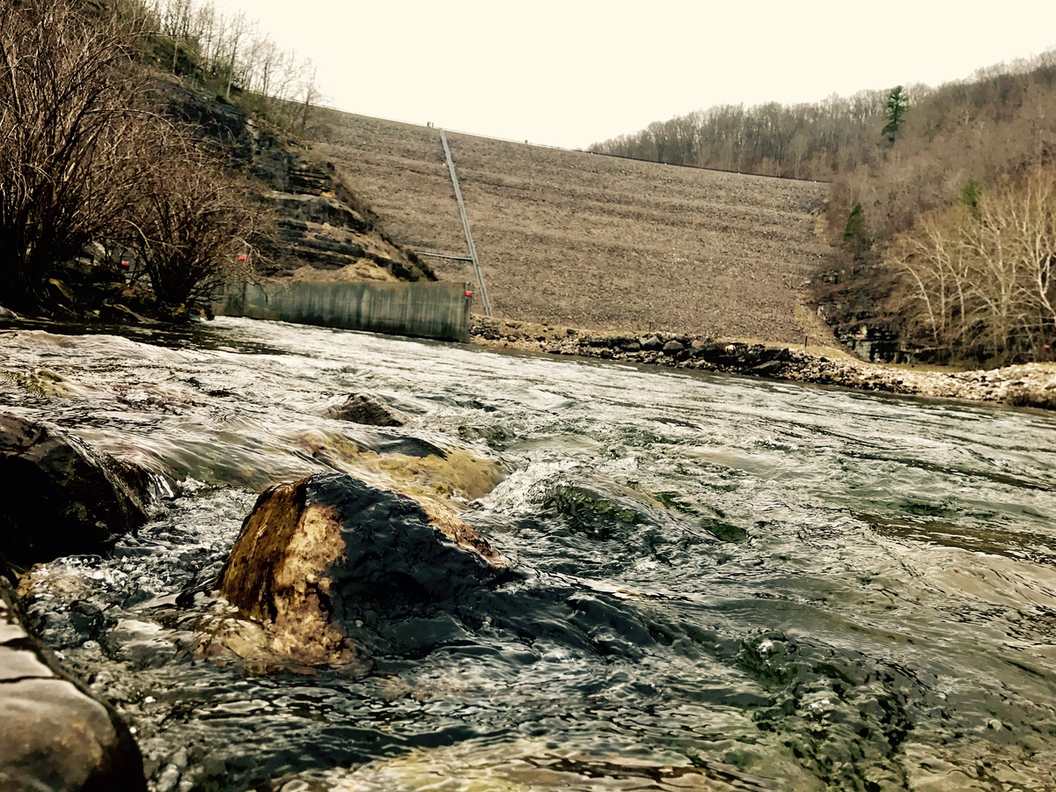
The Jackson River below Gathright Dam is a wild trout river that exists because of a decision made about water. Virginia’s Department of Wildlife Resources (DWR) calls it “the premier wild trout tailwater in Virginia,” a cold, clear stretch of river below Lake Moomaw in Alleghany County where rainbows and browns reproduce on their own and smallmouth bass and rock bass share the water. Above the lake the river is mostly private, and the lake itself is a deep, two-story reservoir that holds trout, bass and big yellow perch. This guide covers the rules for each section, the access list, the land-access caution DWR gives and what flows mean for safety.
The tailwater below Gathright Dam
DWR says six public areas give access to 18 miles of legally navigable water between the dam and Covington. The wild fish are rainbow and brown trout, smallmouth bass, rock bass and redbreast sunfish. A 2015 DWR report puts the water immediately below the dam usually between 58 and 60 degrees Fahrenheit, and describes the recreational reach as running from the stilling basin to the water treatment plant intake in Covington. It also describes the trout fishery as dominated by rainbows under 12 inches, with brown trout making up most of the fish between 12 and 16 inches and browns over 18 inches becoming more common in recent years. A 21-inch brown taken on a streamer in fall is one of the fish DWR pictures on its page. The history of how the river got cold is in the cold-water tale.
DWR’s rule for the tailwater, from the dam to the Westvaco Dam at Covington, has a split slot. No rainbow trout 12 to 16 inches and no brown trout under 20 inches may be kept; they must be released immediately. The daily limit is four trout combined, and only one of the four may be a brown trout over 20 inches. Bait is allowed and there are no gear restrictions. The aim, according to DWR, is to let anglers keep the abundant small rainbows, which helps the rest grow into the slot, and to protect browns so more reach trophy size. The rules snapshot above quotes DWR.
Access points
DWR lists these access sites below the dam, from upstream to downstream: Gathright Dam, Johnson Springs, Smith Bridge, Indian Draft, Petticoat Junction, Water Plant, City Park, Island Ford, Low Moor, Dabney Lancaster and Lick Run, and each has a map on its page. DWR’s text counts six public areas on 18 miles while its map list names eleven sites, so treat the list as the working guide and check the map for each before you drive. A new accessible fishing pier on the river also has a DWR flyer. Below Covington the river is mostly smallmouth, redbreast and rock bass water, and DWR says launch facilities there are still being planned.
Private land: read this before you wade
Above the lake: Hidden Valley and the Bath County section
Large lake-run rainbows enter the Jackson above Lake Moomaw in winter and spring, and DWR points anglers to the Hidden Valley reach. A three-mile section in Bath County, from the Forest Service swinging bridge near the mouth of Muddy Run up to the last ford on Forest Service Road 481D, is stocked several times a year and always holds trout. It can be reached only on foot, from the Hidden Valley area or from Route 623 and Forest Service Road 481. The rule there is a 16-inch minimum and two trout a day, multiple-hook artificial lures are permitted, and a trout license is required from October 1 through June 15.
Lake Moomaw
Lake Moomaw covers 2,530 acres, reaches 152 feet deep and has 43 miles of undeveloped, wooded shoreline. DWR calls it a two-story fishery: warm-water fish near the surface and stocked rainbow, brown and brook trout in a cold, oxygenated layer about 15 feet down. Alewives are the forage base. DWR says brown trout of 3 to 5 pounds are not unusual and are most active in late winter and early spring in 15 to 20 feet of water. Smallmouth hold along rocky shorelines and cliffs, largemouth on the shallow flats near Greenwood Point, and DWR notes yellow perch grew to trophy size here and that a state record was set in 1999. Crappie, bluegill, redear sunfish, channel catfish and chain pickerel round out the list.
On the lake, trout are two a day with a 16-inch minimum, bait is allowed, and neither a trout license nor a National Forest stamp is required. Bass are five a day, and bass under 12 inches must be released. The lake is drawn down 10 to 15 feet each year, starting in June.
Flows and safety
The U.S. Army Corps of Engineers controls releases from Gathright Dam to protect downstream water quality, manage floods and provide recreation. The 2015 DWR report records scheduled pulse releases and flood-storage releases, and notes a 2014 episode in which about 89 trout died with no definite cause. We have no live gauge data on this page. Check the river level and any release notice before you wade, and stay out of the river when flows are rising.
Tackle that suits the river
Anglers on the tailwater commonly use a light to medium fly rod around 9 feet for nymphs and streamers, or a light spinning rod with small spinners and jigs. These are typical choices and not rules. A rod built for the line weight you fish and the water you wade will suit a river where a long drift and a delicate presentation matter.
License
You need a Virginia freshwater license. A trout license is required only in designated stocked trout waters from October 1 through June 15, which includes the Bath County section, but not on Lake Moomaw. The license guide has the details, and the trout roundup compares this river with Mossy Creek and the stocked waters.
Check before you go
DWR’s Verona office handles questions about the river at (540) 248-9360; ask for Fisheries. Compare the other mountain river in the New River guide.
Fish you can target here
Dock Tales from this water
Nearby waters
Virginia Fishing License, Limits and Rules
More fishing guides for Virginia
Frequently asked questions
What is the trout rule on the Jackson River tailwater? +
No rainbow trout 12 to 16 inches and no brown trout under 20 inches may be kept. The limit is four trout combined, with only one brown over 20 inches.
Can I fish anywhere on the Jackson River? +
No. Much of the river above Lake Moomaw is private, and riverfront owners have won trespass claims in two marked sections. Use public access sites or National Forest land, or ask permission.
Do I need a trout license at Lake Moomaw? +
No. DWR says neither a trout license nor a National Forest stamp is required there. The Bath County section of the Jackson does require one from October 1 to June 15.
Sources
- Virginia DWR: Jackson River (accessed November 1, 2026)
- Virginia DWR: Lake Moomaw (accessed November 1, 2026)
- Virginia DWR: special regulation trout waters (accessed November 1, 2026)
- Jackson River Tailwater Report 2015 (DWR) (accessed November 1, 2026)
Approximate location: Lake Moomaw, Covington, VA.