
How to Catch Muskie: Gear, Bait and Technique
Last verified:
By BCRods
Quick facts
- Where
- Weed edges, points, humps and deep structure
- Best seasons
- Fall, late spring and early summer
- Rod
- 7 to 9 ft heavy or extra-heavy casting rod
- Line
- 80 to 100 lb braid with a wire or heavy fluorocarbon leader
Muskellunge, or muskie, is the largest freshwater predator in many East Coast lakes, and catching one takes patience, heavy tackle and a lot of casts. They are often called the fish of ten thousand casts. This guide covers how to recognize a muskie, where to look, the heavy gear that is needed, the lures that work, three techniques and how to handle a fish safely, since a muskie’s teeth are dangerous and the fish is usually released. Rules differ by state and by lake, so always check your state’s current guide.
Know the fish
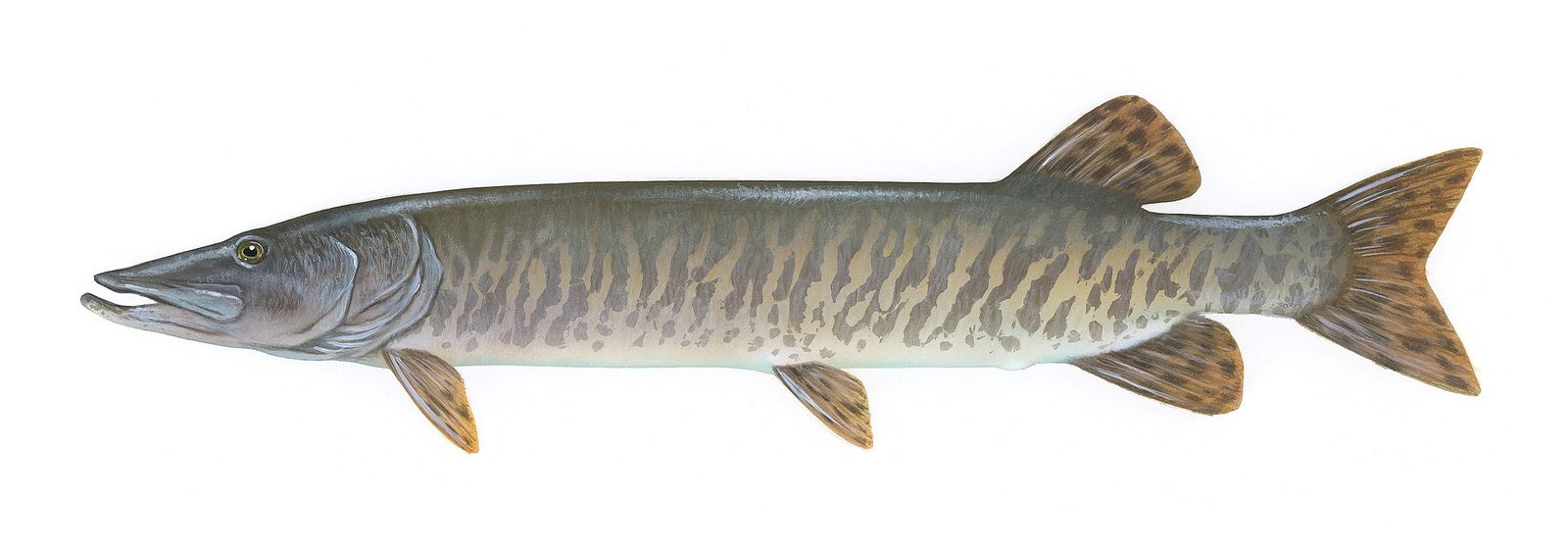
A muskie is a long, torpedo-shaped fish with a flattened, duck-like snout and a mouth full of sharp teeth. Its sides are pale with darker vertical bars or spots, and its tail is forked. It can be confused with northern pike and with tiger muskie, a hybrid, and rules sometimes treat them differently. Pike have light spots on a dark body, and muskie have dark markings on a light body.
What they do
Muskie are ambush predators. They hold near weeds, rock edges, points and drop-offs and strike fish, ducks or anything that looks like prey. They follow a lure to the boat, which is why anglers finish each cast with a figure-eight at the boat. They are less abundant than most game fish, and they grow slowly.
Where to look
Look on structure near deep water: weed edges, points, humps, rocky shoals and the edges of channels. The Fisherman describes Lake Hopatcong in New Jersey as holding muskies along with walleye, bass, pickerel and hybrid striped bass. New Jersey manages Hopatcong, Echo Lake Reservoir, Greenwood Lake and Monksville Reservoir as Trophy Muskie Waters with a larger minimum size.
Tackle that fits
Rod. A 7 to 9 foot heavy or extra-heavy rod, built for big lures and hard hooksets.
Reel and line. A large baitcasting reel with 80 to 100 pound braid.
Leader. A wire or heavy fluorocarbon leader is needed because of the teeth.
Net and tools. A large net, long-nose pliers, jaw spreaders and cutters, and a hook-out tool.
These are typical setups, not requirements.
Baits and lures
Large inline spinners, bucktails, jerkbaits, glide baits, swimbaits and big topwater lures are the standards. Live suckers on a quick-strike rig are used where bait is allowed. Lures can run 6 to 12 inches. Color is less important than size, action and depth.
Three techniques
Casting and the figure-eight. Cast and retrieve along weeds and finish by pulling the lure through a wide figure-eight beside the boat, since many fish follow without striking.
Trolling. Pull large lures along the weed line or a breakline at several depths, and work the lures near points and humps.
Fishing at dawn and dusk. Low-light hours are often the best, and a sudden change in weather can trigger feeding.
Seasons and conditions
Muskie fishing is often best in fall, when fish feed to build up for winter, and in late spring and early summer. Some states close the season or require catch and release at certain times. Weather fronts and water temperature shape the bite, and the fish often feed hard just before a front.
Shore and boat
Most muskie anglers fish from a boat, since the structure is out from shore. Shore anglers can cast from points and docks where access is allowed. Check motor limits and ramp rules for the lake you fish.
Common mistakes
- Using light line or no leader.
- Skipping the figure-eight at the boat.
- Not having tools to remove hooks.
- Keeping a fish that is under the legal size for the lake.
- Fishing without a plan to handle the fish.
Expert tips
Keep the net in the water or ready before the fish arrives. Fish slowly and cover water methodically, and note where fish follow a lure and return later. Take photos fast.
Handle fish with care
Muskie are hard on themselves in a fight, so land them quickly, keep them in the water and support the belly. Never put your fingers near the gills or in the mouth. Use jaw spreaders and long-nose pliers, and cut a hook if it is deep. Revive the fish facing the current until it swims off. In the warm months, release mortality rises, so keep fights short.
Muskie in New Jersey
New Jersey’s statewide muskie minimum is 40 inches with a limit of one fish, and its four Trophy Muskie Waters have a 44 inch minimum. The Delaware River limit is 40 inches. See best lakes for fishing in New Jersey for the lakes, and the rules guide for the licenses.
Build the rod to the water
A muskie rod is built for heavy lures and long days. Tell us where you fish and which lures you throw, and we will build the rod around them.
In Pennsylvania
Pennsylvania’s statewide muskellunge rule is 40 inches and one fish, but Pymatuning Reservoir uses a 30 inch minimum and two fish. See our Pennsylvania lakes guide and the Pennsylvania rules guide.
Frequently asked questions
What is the best lure for muskie? +
Large bucktails, inline spinners, jerkbaits, glide baits and swimbaits.
Do I need a wire leader? +
A wire or heavy fluorocarbon leader is needed because of the teeth.
Sources
- eRegulations New Jersey: freshwater size, season and creel limits (accessed November 2, 2026)
- The Fisherman: Lake Hopatcong, NJ (2019) (accessed November 2, 2026)